Facial Demorphing from a Single Morph Using a Latent Conditional GAN
Nitish Shukla, Arun Ross; In Proceedings of IEEE International Joint Conference on Biometrics (IJCB 2025)
Abstract
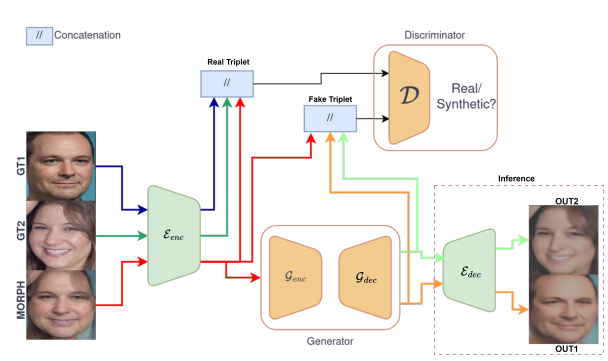
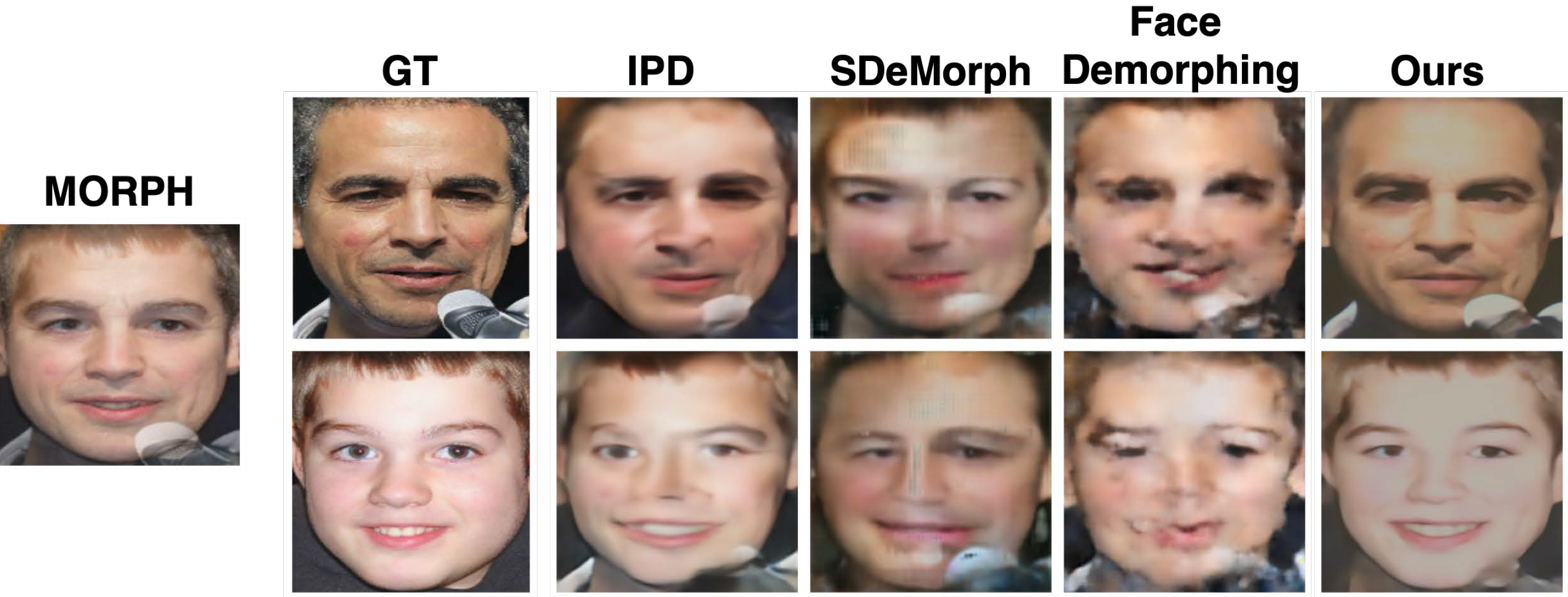
A morph is created by combining two (or more) face images from two (or more) identities to create a composite image that is highly similar to all constituent identities, allowing the forged morph to be biometrically associated with more than one individual. Morph Attack Detection (MAD) can be used to detect a morph, but does not reveal the constituent images. Demorphing - the process of deducing the constituent images - is thus vital to provide additional evidence about a morph. Existing demorphing methods suffer from the morph replication problem, where the outputs tend to look very similar to the morph itself, or assume that train and test morphs are generated using the same morph technique. The proposed method overcomes these issues. The method decomposes a morph in latent space allowing it to demorph images created from unseen morph techniques and face styles. We train our method on morphs created from synthetic faces and test on morphs created from real faces using different morph techniques. Our method outperforms existing methods by a considerable margin and produces high fidelity demorphed face images.
Resources
Results


Citation
If you use this work, please cite:
@inproceedings{shukla2025demorphing,
  title={Facial Demorphing from a Single Morph Using a Latent Conditional GAN},
  author={Shukla, Nitish and Others},
  booktitle={International Joint Conference on Biometrics (IJCB)},
  year={2025}
}