Facial Demorphing from a Single Morph Using a Latent Conditional GAN
Nitish Shukla, Arun Ross; In Proceedings of IEEE IJCB 2025
🏆 IAPR Best Biometrics Student Paper Award (BBSPA), IEEE IJCB 2025.
Research Goal
Demorphing methods often suffer the morph-replication problem — both outputs end up looking like the input morph — or assume train and test morphs share the same morphing technique. This work demorphs in a compressed latent space, recovering constituent faces from morphs made with unseen techniques and face styles, at high resolution.
How it works
- Perceptual compression. A frozen Stable-Diffusion KL-autoencoder maps a 512×512 morph to a 64×64×4 latent, stripping away distractors (background, lighting, morph artifacts) and making training/inference far cheaper.
- Conditional GAN in latent space. An image-to-image generator conditioned on the encoded morph demorphs in the latent domain; a discriminator separates real vs. synthetic triplets (encoded morph + two faces). Computing losses in latent space avoids penalizing irrelevant RGB differences.
- Kurtosis loss against replication. Beyond adversarial + $\mathcal{L}_1$ losses, a kurtosis term aligns the higher-order statistics of outputs and ground truth, preventing the “average face” trivial solution that plagues passport-style morphs.
- Order-robust training. Outputs are explicitly ordered but ground-truth pairs are randomly swapped, exposing the model to both orderings with a simple per-pixel loss.
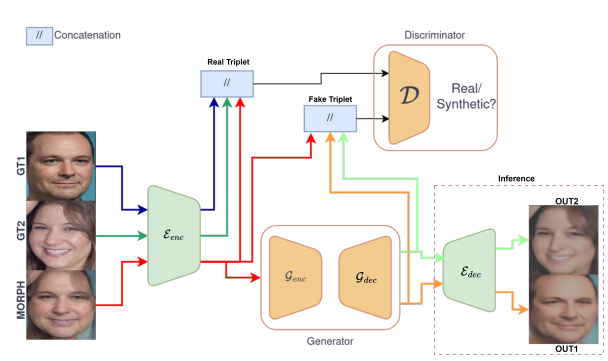
A frozen encoder compresses the morph; a conditional GAN demorphs in latent space and a decoder reconstructs the two constituent faces at inference.
Key results
- 97.77% TMR@10%FMR on AMSL (ArcFace), versus 70.55% for the prior GAN baseline.
- Outperforms SDeMorph and Identity-Preserving Decomposition across all datasets on TMR, Restoration Accuracy, IQA, and the biometrically cross-weighted BW-IQA metric.
- Live human study (17 images, 8 subjects, 28 morphs): 95.65% RA with AdaFace, 91.30% with ArcFace — confirming the method works beyond benchmark morphs.
Resources
Results

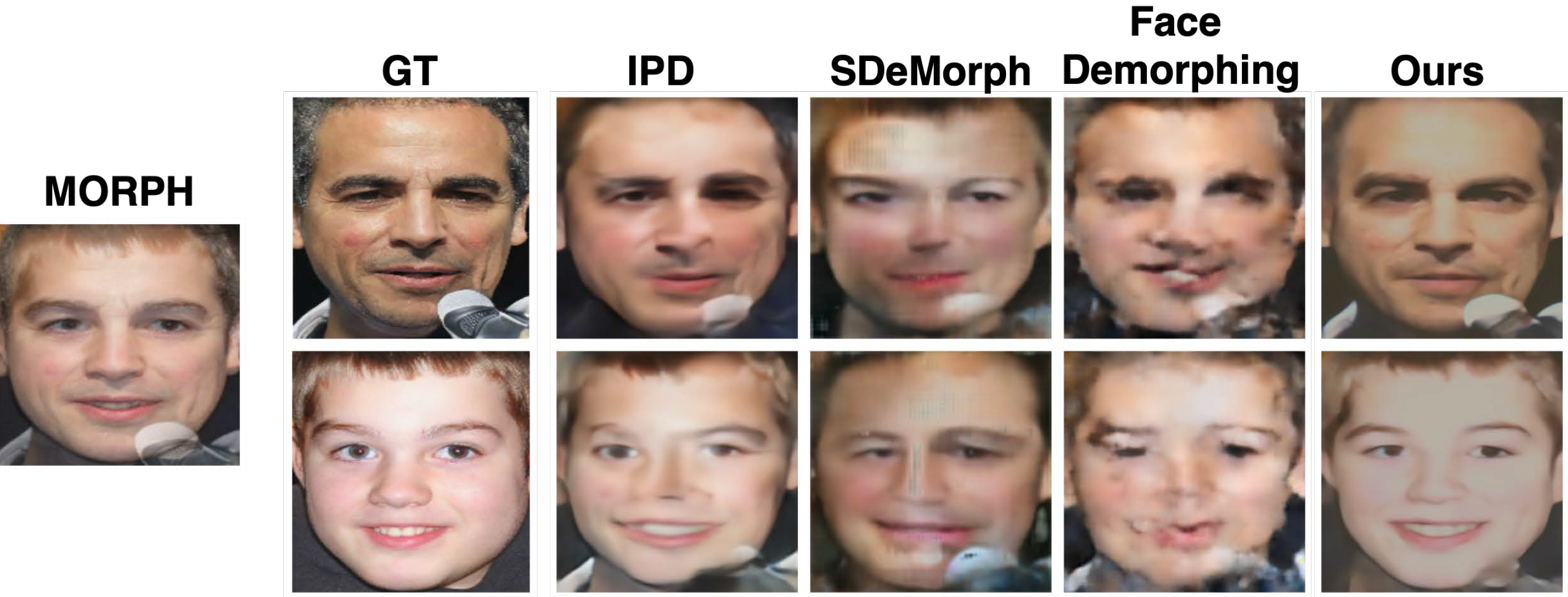
(Left) Demorphing outcomes across six morphing techniques. (Right) Comparison with the state of the art under a unified protocol.

Evaluated with IQA (PSNR/SSIM), Restoration Accuracy, and biometrically-weighted IQA (BW); our method outperforms IPD, SDeMorph, and Face Demorphing.
Citation
If you use this work, please cite:
@inproceedings{shukla2025lcgan,
  title={Facial Demorphing from a Single Morph Using a Latent Conditional GAN},
  author={Shukla, Nitish and Ross, Arun},
  booktitle={IEEE International Joint Conference on Biometrics (IJCB)},
  year={2025}
}